
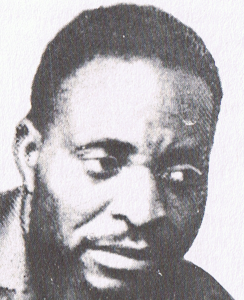
 1972 Military Commander, ZANLA.
Chief of Defence, DARE ReChimurenga (ZANU War Council).
Josiah Magama Tongogara was born in Selukwe (Shurugwi) in 1938. He obtained his primary education, up to Standard VI, at an Anglican mission school.
He went to Northern Rhodesia (Zambia) in 1960 and studied book-keeping. He became secretary of Chainama Golf Club in 1961. When he suspected that his brother Percy, who was drowned in the Kafue river, had been the victim of political foul play Tongogara left his employment and became a militant nationalist.
He travelled extensively throughout the Middle East, the Far East and Eastern Europe, studying politics and training himself as a military leader1 In 1972 he became military commander of ZANLA. He also headed the 18-man military high command, providing liaison between the political leaders in Lusaka and the soldiers in the field.
He escorted Gerald Hawksworth from Mocambique to Tanzania after the latter had been captured by guerrillas in 1973.
During the Lusaka discussions of December 1974 he stood out firmly against detente, maintaining that the military struggle must be continued. Despite a great deal of internecine fighting between the various tribal elements of ZANLA he managed to remain in control.
Following the death of Herbert Chitepo in March 1975 Tongogara was detained by the Zambian Government. He was held in Kabwe maximum security prison for over a year, being brought to trial in Lusaka on 21 April 1976 for the alleged murder of Chitepo. On 20 October he was acquitted and released in time to attend the Geneva Conference.
Although in prison at the time, he was a signatory to the agreement which set up ZIPA in May 1976.2
Tongogara is Chief of Defence of DARE ReChimurenga (Supreme Council of ZANU) and commander-in-chief of ZIPA.
He is a tough, clear-thinking man with positive ideas on political development. He greatly admired Patrice Lumumba and Mao-Tse-tung and there is little doubt that he is a committed Marxist3 So intense is his political commitment that he carries a radio with him wherever he goes for fear of missing important news items from Peking and other Communist stations.
Tongogara is married with three children (Rangarirayi, Hondo and Bvumai). His wife, Angelina, is a midwife. For relaxation he likes to watch soccer and Kung Fu films. When he comes in from he bush he likes to “wind down with draughts and cards”.
The following post-independence review of Josiah Tongogara was written by Diana Mitchell and appears in her 2021 memoirs
JOSIAH TONGOGARA
Josiah Tongogara had died in what are euphemistically described as ‘mysterious circumstances’ (there were many such deaths in the new Zimbabwe) on his way back into the country from Mozambique on the eve of Independence. All ‘official’ denials are pointless; everyone opposed to the Mugabe regime will prefer to believe that Tongogara, the popular ZANLA general, was killed on the orders of Mugabe. Why? One reason touted was that at the 1979 Lancaster House talks preceding the agreement to a new Zimbabwe Constitution, he had held out against his Commander-in-Chief (Mugabe) in favour of ending the war. His friendly attitude to Ian Smith: “Your mother once gave me sweets when I was a boy in your hometown, Selukwe…” was the cause of much comment by witnesses to their meeting at Lancaster House.
Mugabe wanted to fight on for the Rhodesians’ unconditional surrender. Tongogara had retained the loyal following of the fighting men and was therefore, not beloved of the politician, Robert Mugabe. Being as popular as he was reported to be with the guerrillas under his direct command, he would have been feared as a possible threat to Mugabe’s new-found power. Robson Manyika, one of his fellow war-time commanders told me this when I interviewed him after Independence. Manyika’s was another of the unexpected and unsatisfactorily explained deaths not long after Independence.
1 According to a report in the Daily Telegraph (12 April 1976) he is a close friend of Mocambique’s President Machel, with whom he underwent military training in China. It is also stated that he fought alongside Machel at one time in the Tete province of Mocambique.
2 ‘ZlPA was formed out of the ZANU armed force, ZANLA,‘and the ZAPU guerrillas’ (writes Claudette Monteiro in African Development 1233). ‘The ZANLA forces were by far the larger section ofthe armed forces, and they never agreed to the ceasefire under ‘detente’ with South Africa; this brought about some conflicts within ZANU and ZANLA. ZANU seemed to be a party to the ceasefire, but ZANLA did not want it. This caused some thinking among ZANLA cadres which led them to join up with the ZAPU cadres…’ Claudette Monteiro goes on to say that ‘trouble erupted earlier this year (1976) when the political leaderships of both ZAPU and ZANU were excluded from the camps. This was resented by sections of the cadres… who gave their allegiance first and foremost to Nkomo or Sithole or whoever and were prepared to fight purely on that basis.’
3 See Daily Telegraph (12 April 1976).